A Pastor from Siauliai Blessed Her Son's Marriage in Denmark, Then Celebrated His Wedding in Uganda
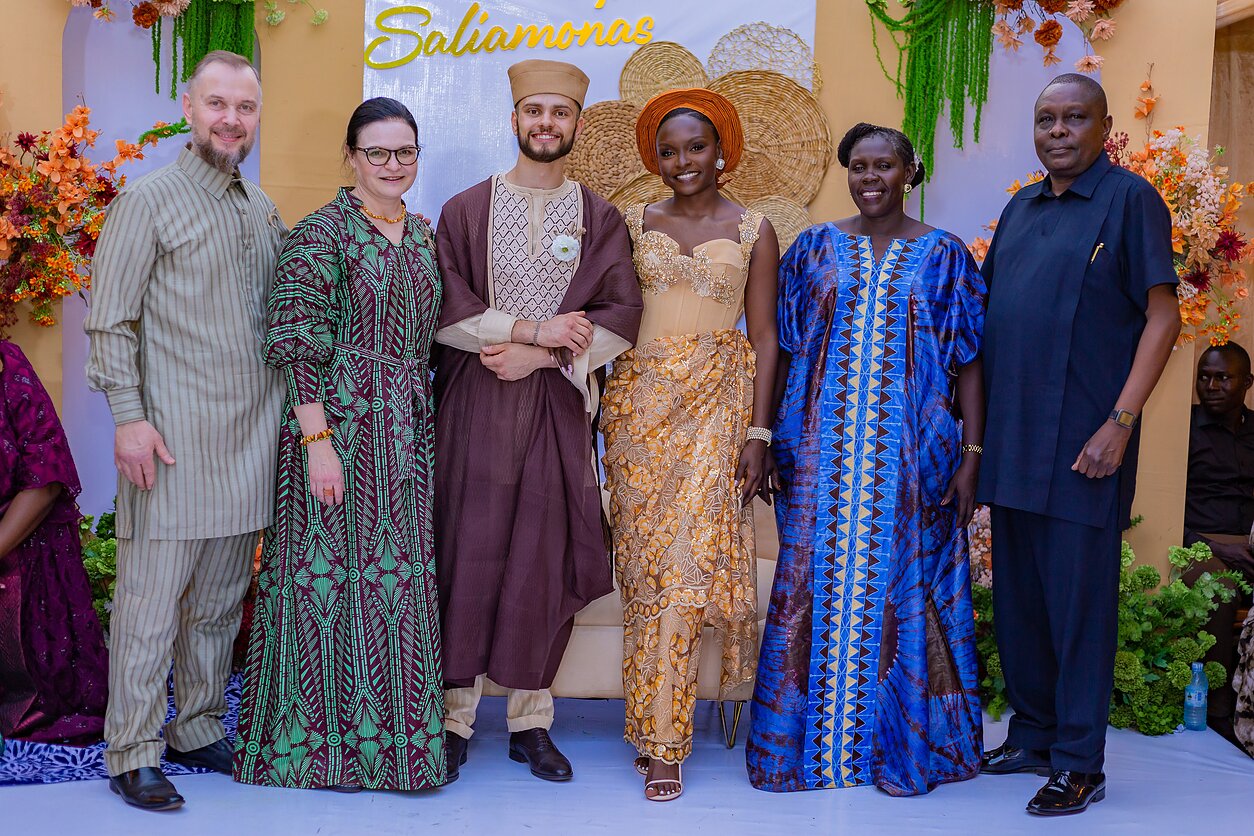
When Anželika Krikštaponienė, who lives in Siauliai, tells a new acquaintance that she is a pastor, people often raise an eyebrow. She then explains that she is a minister, much like a priest, and things become a little clearer. Speaking to LRT.lt, she shared how she chose such an unusual path in life, and spoke about her son Saliamon's wedding. The marriage was blessed by no fewer than four pastors, while the main celebration took place in exotic Uganda, the homeland of her son's chosen bride.
The Article in Brief
- Anželika Krikštaponienė is a pastor and has been involved in pastoral ministry for 35 years.
- As a teenager reading Holy Scripture, she wondered how life as a whole would fall into place if people lived as it teaches.
- The pastor's husband, Aidas, also serves in the church, and according to her, their three children have been "touched by faith."
- When she heard that her son had met a beloved from Uganda with an African appearance, she was very surprised, but she supported him.
- The traditional wedding in Uganda had two parts; as many as 400 guests attended the second part.
Anželika has noticed that her choice of life path still surprises Lithuanians, while in some other Western countries women pastors already seem quite ordinary. While visiting Denmark, she personally met women pastors in different churches. In Great Britain, Sarah Mullally was recently elected the first female Archbishop of Canterbury in the Anglican Church. In the United States, various congregations have had women clergy since the mid-19th century.

Anželika became a pastor soon after the restoration of independence, although at that time it still seemed very unusual in Lithuania. She has been involved in pastoral ministry for 35 years and is the pastor of the Tiesos žodis church. She counsels people in matters of pastoral care, holds prayer meetings, communicates with church leaders, devotes time to the study of Holy Scripture and theology, teaches and preaches, takes part in interdenominational and public activities, and more. She noted that for a person to become a minister, what matters is not gender, but whether the person has a calling, as well as professional pastoral preparation.
Anželika grew up in a family of intellectuals - her parents were geologists and engineers. From childhood she leaned toward art, and she was also interested in questions about the human soul and what happens to it after death. As a teenager, Vincas Mykolaitis-Putinas' novel In the Shadow of the Altars made a strong impression on her. She also read Gospel Legends with interest; although it was a Soviet book intended as a critique of religion, it contained quotations from Holy Scripture, which at that time was banned.

Once, when Anželika was 15 or 16, her mother came home and told her that one of her colleagues, an engineer, spent her lunch break reading Holy Scripture very attentively, while others chatted or rushed off to the shops. "I asked my mother whether her colleague might lend us that book. She agreed, and then my mother and I both read it - a Russian translation. The text captivated me from the very first lines. I felt that everything written there was true. After reading it, I kept thinking how life as a whole would fall into place if people lived the way it says there," Anželika recalled.
Better a Good Pastor Than a Bad Painter
When the Lithuanian National Revival began, a thirst for faith became visible in the nation, and people started taking a much greater interest in spiritual matters. After the Soviet period, churches of various denominations came back to life in Lithuania, and some communities emerged from underground - Pentecostals, for example. At that time, in 1989-1990, Anželika began to enjoy talking with her friends about biblical and spiritual topics, and eventually they formed a small spiritual group of believers in Siauliai.
"I was studying art, but it seemed the Lord was calling me. In 1991 we founded the Tiesos žodis community, and I became its pastor. Before that I told myself I would do it if my father blessed me, because he had sincerely supported my art studies - and he did. He said it would be better for me to be a good pastor than a bad painter," Anželika said.
The Siauliai church Tiesos žodis is registered with Lithuania's Ministry of Justice and has had legal status since the very beginning of its establishment. Anželika assured that their relations with other denominations, including the Catholic Church, are good.

"To people who are not interested in these things, it may seem that there are only a few main churches. In reality, there have always been far more Christian churches. Some are old and traditional, others are new, independent, and modern. In Siauliai, ecumenical fellowship among different Christian denominations has been nurtured for more than 30 years. Evangelicals, Orthodox Christians, and Catholics gladly pray together and look for opportunities for shared ministry, even for ways to support one another by extending a helping hand.
"Or take Lithuanian churches, where new Lithuanian hymns are constantly being born. Hymns created, for example, by Gintautas Abarius and other authors have been taken over from us and are gladly sung by Catholic, Pentecostal, and some other churches. And we sing hymns created elsewhere," Anželika said.

For Her Son, She Wished for a "Godly Wife"
One of the obvious denominational differences is that in Catholic churches, clergy observe celibacy, while in Evangelical churches they may marry and have families. Anželika's husband, Aidas, has served with her in the Tiesos žodis church for more than three decades.
The pastor said that he grew up in a devout Catholic family. His mother taught her son both formal prayers and encouraged him to pray in his own words, repeatedly telling him, "Ask God for a godly wife." True, her mother-in-law probably never dreamed that her son's chosen wife would be so "godly" that she would even serve at the altar.

The two met in 1990 at the birthday party of one of Anželika's friends. During the celebration, the young people began sharing thoughts about faith, and the man was touched by what she said; he asked her to tell him more. Soon he joined the youth group she had gathered. They decided to marry when the young man answered that he longed to serve God together with her and that her calling to be a pastor was no obstacle to him. This year the couple will celebrate their 35th wedding anniversary. They raised three children; there was a fourth, but he passed away when he was still very little.
The couple's two older children are already adults and married. Only their teenage son still lives with his parents and, according to his mother, is the joy of their eyes. Their daughter Akvilė lives with her husband in Copenhagen, Denmark, and their middle son Saliamon has also settled there. All the children, as Anželika says, have been "touched by faith."

A Daughter-in-Law from a Country Few Had Heard Much About
This February, Anželika and her husband attended their son Saliamon's wedding - and not just anywhere, but in exotic Uganda. Some time earlier, her son had told his mother that in Copenhagen, in an international youth Bible group, he had met a lovely girl named Belinda, with whom he found it interesting to talk about all kinds of topics, and that she came from Uganda. He asked his mother what she thought about it.
"Of course I was surprised - and now we say that Belinda is our exotic daughter - but I asked whether the two of them found a common language, whether they felt cultural differences, and he said no. He even said she reminded him of me and of his grandmother, his father's mother. Of course I had never dreamed I would have such a daughter-in-law, but my son assured me that she was his person, that they got along beautifully and had much in common. And for me it was a beautiful testimony that she came from a Christian family and is herself a young woman of deep faith," Anželika said.

The mother also asked how the girl's relatives accepted her son, and he replied that they received him very warmly. He communicates with her uncle, who also lives in Copenhagen, and speaks remotely with her parents as well. "What is interesting is that Belinda's father is Catholic, her mother is Anglican, and we are Evangelical Christians, but this truly does not get in the way. We told our children that they choose for themselves, but it is very pleasing that the people they have chosen are Christians. We also told our children that family life would be easier to live with the Lord's wisdom, but we did not interfere in their choices," Anželika said.
It Felt Like Being in a Film
Belinda and Saliamon first registered their international marriage in Copenhagen. The celebration in Denmark was modest, with only the closest people present, but the mother was moved by the newlyweds' request that she bless their marriage. A much larger celebration took place in Uganda soon afterward, and Anželika, her husband, and their other children also took part.

"Belinda's family is large; she has four brothers, and for all of them family is a true value. So they decided to celebrate there, and we travelled to their country, about which we had heard very little before. We felt as if we were in some kind of film," Anželika said.
The wedding in Uganda had two parts. The first part of the celebration, called the traditional wedding, took place on February 7, while the main celebration with the Christian marriage blessing ceremony took place on February 14.
In the first part, the traditional wedding, the families of the groom and bride get to know one another. The woman introduces her chosen one to the family, and everyone introduces themselves to one another through dance: aunts, brothers, cousins, and other relatives. Uncles and elders give speeches. There were also national games: the main aunt searched among the guests for the hidden groom. After that, the groom had to recognize his bride among her cousins, whose faces were covered with light silk scarves.

All the guests - the very closest relatives, about 200 of them - wore bright, colorful national clothing of the country. The bride provided such clothing for the guests from Lithuania as well. Special attention was shown to the parents: both the Ugandan parents and the Lithuanians.

"We gave blessing speeches to the young couple. Our family came onto the platform to the song Ant kalno mūrai, joja lietuviai, whose music and translated lyrics made a strong impression on the bride's relatives. We exchanged various national gifts. At the end of this celebration, the newlyweds were blessed by an uncle who is a pastor of an Evangelical church and serves his community together with his wife. By the way, she led both weddings beautifully together with another professional host," Anželika shared.
She added that all the people were very warm, friendly, supportive of one another, and it was very pleasant to communicate with them. They spoke English with the locals, because Uganda was a former British protectorate; unlike colonies that Britain ruled directly, Uganda retained local rulers and traditional kingdoms such as Buganda. True, the members of her daughter-in-law's family speak several tribal languages among themselves, and there are about 40 in total there.

The second part of the celebration, which took place a week later, included the couple's vows and blessing. This ceremony was led by two more pastors, a senior and a younger pastor, so in total the newlyweds received the blessing of four pastors from different churches, including the one Anželika gave in Copenhagen. And there was no shortage of national food, dancing, merriment, and laughter in either part of the celebration.
The first part of the celebration took place in the yard of the bride's parents' home, where tents had been set up for the guests. The Christian ceremony and the festivities that followed took place in a private park with palm trees and a pond, where a separate stage and one large tent had also been set up. This time it held as many as 400 guests - friends of the newlyweds, former classmates, and colleagues joined the family members and relatives.

A Developing Country with Hardworking People
The wedding took place in Uganda's capital, Kampala, which the Lithuanians reached via Istanbul. The distance one way was about 9,000 kilometers. What impression did Uganda, located in the center of Africa near Kenya, leave on the woman from Siauliai overall? "In truth, in Lithuania we know little about Africa, and we have also heard quite a few myths. Winston Churchill, in his travel diary, called Uganda the Pearl of Africa. Near Lake Victoria are the sources of the Nile. Here, local and Christian culture intertwine subtly and without aggression. Perhaps there are places where it would not be safe for white travelers to visit alone, but locals accompanied us everywhere, so everything seemed simple," Anželika said.

According to her, local people are tidy and hardworking, as well as entrepreneurial, and the state, which is fairly advanced, encourages that entrepreneurship, especially small business and agriculture. There are many open-air markets in the streets, where one can buy everything needed - from food to building materials. The country is developing, new roads are being built, and modern buildings are going up. Locals dress impressively, especially women, who do not shy away from traditional clothing even in everyday life. Anželika assured that no one there asks travelers for money; that simply is not part of the culture.

"What is also very convenient in the country is that, because it lies on the equator, the temperature in both winter and summer is 26-30 degrees Celsius; the sun always rises at 7 a.m. and sets at 7 p.m. What we liked most was that Lithuania and Uganda are in the same time zone, except that Lithuania has daylight saving time. The country has 10 official national parks, covering up to 20 percent of its territory, and there is much to admire there. We had the honor of visiting one of them with the newlyweds and several of Belinda's relatives - the largest in the country, Murchison Falls National Park, known for its powerful Nile waterfall and wildlife safaris," Anželika said.
It is likely that this was the first, but not the last, trip to Uganda for her and her husband - her daughter-in-law's relatives emphasized that the new family members from Lithuania would always be welcome there.